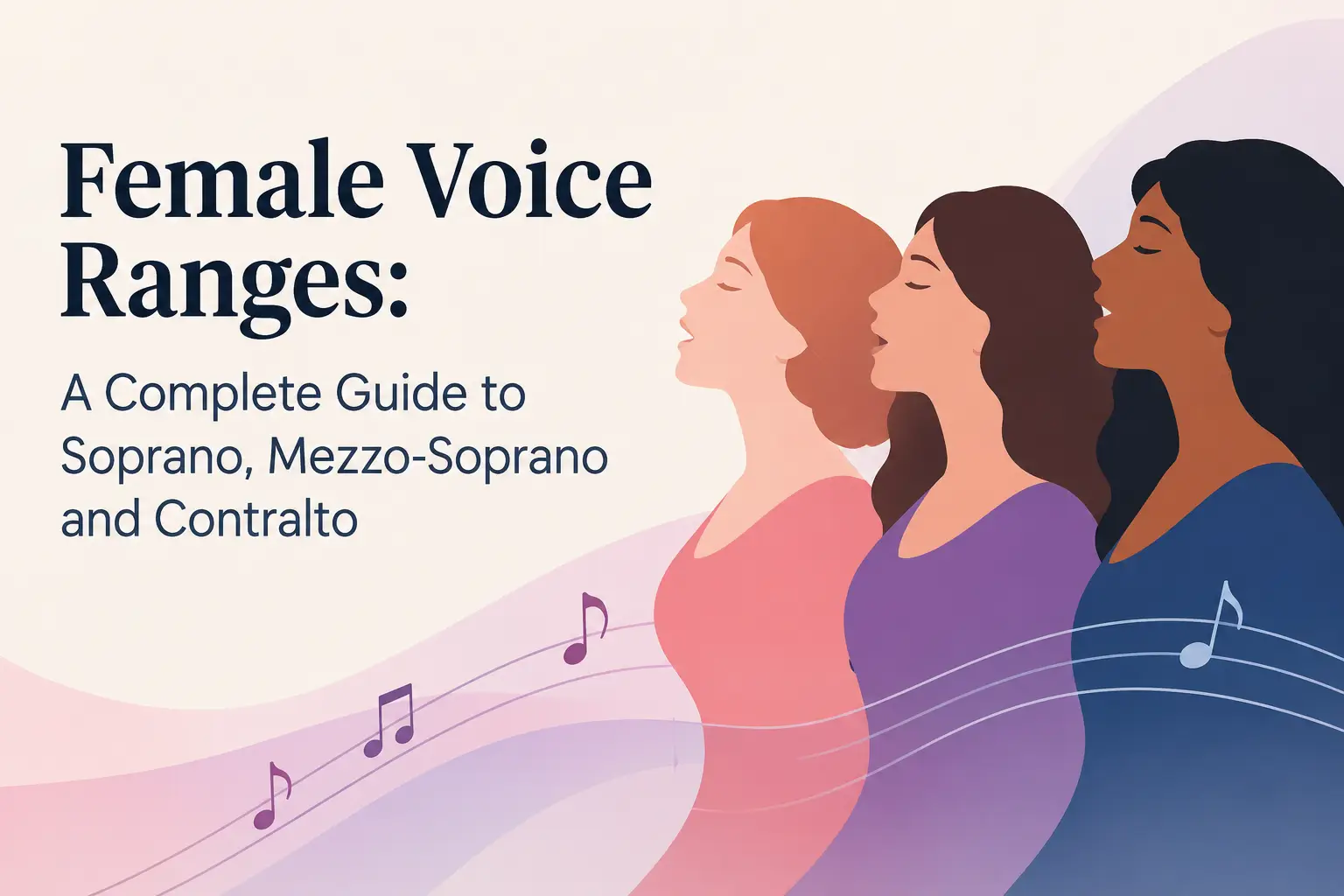
If you can sing a high note, are you a soprano? If you sing alto in a choir, does that make you a contralto?
Neither question has a one-note answer. Female voice ranges overlap, and a singer’s highest or lowest note tells only part of the story. The notes that feel comfortable through an entire song matter more than one note reached once.
This guide explains the three main female voice types, how to read a range chart, and how to explore your own voice without forcing it into a label.
What Are the Female Voice Types?
In classical singing, voices are commonly grouped into soprano, mezzo-soprano, and contralto. Soprano is generally the highest of the three, mezzo-soprano sits in the middle, and contralto is the lowest. These names are especially useful when assigning female vocal roles in opera.
A voice type describes more than pitch. Singers and teachers also listen for where a voice feels comfortable, how it sounds at different pitches, and how it moves between vocal registers. That’s why two people who can sing the same high note may belong to different categories.
The labels can be useful outside opera, but they’re less rigid in pop, musical theatre, and other styles. A song can often be moved to a different key to suit its singer.
Female Vocal Range Chart
The chart below shows approximate reference ranges, not limits every singer must meet. In note names, the number identifies the octave: C4 is middle C, and C5 is the C above it.
| Voice type | Approximate range | General character |
| Soprano | C4–C6 | Comfortable with higher writing |
| Mezzo-soprano | A3–A5 | Often comfortable in the middle register |
| Contralto | F3–F5 | Comfortable lower, with a strong low register |
You’ll find slightly different notes in different vocal range charts. That’s normal: these are guides, and individual voices vary. As the overview of female vocal ranges shows, the categories describe broad patterns rather than a test with exact cutoffs.
What is the typical female vocal range?
There isn’t one pair of notes that represents every woman who sings. A soprano, mezzo-soprano, and contralto can share many pitches. The useful question is where each singer can perform consistently and comfortably.
What is A Soprano’s Vocal Range?
The commonly cited soprano voice range is approximately C4 to C6. A soprano may sing beyond those notes, or have a smaller usable range while developing her technique. What matters is that higher passages sit well in her voice.
A female soprano doesn’t have to sound light or delicate. Sopranos can have different vocal colors and suit different music. In opera, a lyric soprano is one more specific classification, associated with roles that call for a particular balance of warmth, flexibility, and upper-range ease.
The role matters as much as the label. Singing one high note at the end of a song is different from singing phrases that stay high for several minutes. If those phrases feel natural and remain clear, that tells you more about a possible soprano fit.
What is A Mezzo-soprano’s Vocal Range?
A common guide for the mezzo range female singers use is A3 to A5. “Mezzo” means middle, but a mezzo-soprano isn’t simply a soprano who can’t sing as high. Mezzos often have a comfortable, expressive middle register and can also sing impressive high notes.
What’s the difference between soprano and mezzo-soprano?
Their ranges overlap. The clearest difference is usually where the voice feels at home over a whole piece. A soprano may feel free in music that stays high, while a mezzo may find that the same passage takes more effort than music centered lower down.
Opera also shows why the label isn’t a ranking. In a Guardian interview, acclaimed mezzo-soprano Joyce DiDonato described the variety of roles available to mezzos: “we play the princesses and the witches.” She also spoke about playing characters of different genders. Her point is about the expressive possibilities of the voice, not a fixed set of notes.
What is A Contralto’s Vocal Range?
A commonly used guide for contralto is approximately F3 to F5. The distinguishing feature isn’t merely reaching F3. A contralto’s lower notes form a useful, comfortable part of her singing voice rather than appearing only as an occasional effect.
Contralto is often confused with “alto.” If you’re searching for an alto singing voice female range or an alto vocal range female chart, check which meaning the source uses. Alto usually names a lower part in a choir. Contralto describes an individual classical voice type.
A mezzo-soprano can sing an alto choir part. So can a soprano whose choir needs her on that line. Your assigned part tells you what you’re singing in that group; it doesn’t settle your voice classification.
Why Your Highest Note Doesn’t Decide Your Voice Type?
Imagine two singers can both reach A5. One sings it with ease after a page of high phrases. The other can reach it once but feels most confident singing much lower music. Their shared top note doesn’t mean they should sing the same repertoire.
Teachers call the comfortable, useful area of a voice its tessitura. It’s different from range, which runs from the lowest to the highest notes a person can produce. For practical voice classification, tessitura is often the better clue.
Listen to the whole phrase, too. Can you sing the words clearly? Can you repeat the passage without tightening your throat? Does your tone stay steady as you move up or down? Those answers tell you more than an app displaying a single note.
Chest Voice, Head Voice And the Passaggio
As you move through a melody, you may notice changes in how singing feels and sounds. Singers often call a fuller lower sound chest voice and a lighter upper sound head voice. Mixed voice is a teaching term often used for a sound that combines qualities people associate with both.
The transition area is called the passaggio. It isn’t one universal note for all women. Singers learn to move through it smoothly, and teachers may describe the process differently depending on the style being taught.
These changes can offer clues about a voice, but they aren’t a do-it-yourself diagnosis. You don’t need to push chest voice higher or manufacture a lower note to qualify for a particular category.
How to Explore Your Own Singing Range
Start with a few comfortable notes on a piano or keyboard app. Hum gently downward, then upward, stopping before anything feels strained. Write down the notes you can sing clearly and repeatably, rather than the faintest or loudest sounds you can make.
Next, sing short passages in several keys. Notice which ones let you focus on the words and music instead of surviving the high or low notes. Repeat the exercise on another day; tiredness and familiarity with a song can affect what feels easy.
If you’re choosing choir music, ask where your voice blends and stays comfortable throughout rehearsal. If you’re choosing solo repertoire, a singing teacher can help you assess your tessitura, tone, and transitions over time.
So, what are the female singing ranges really for? They’re a starting point for finding music that lets your voice work well. Whether soprano, mezzo-soprano, or contralto eventually fits, the most useful discovery is the part of your voice you can sing with freedom, clarity, and confidence.
