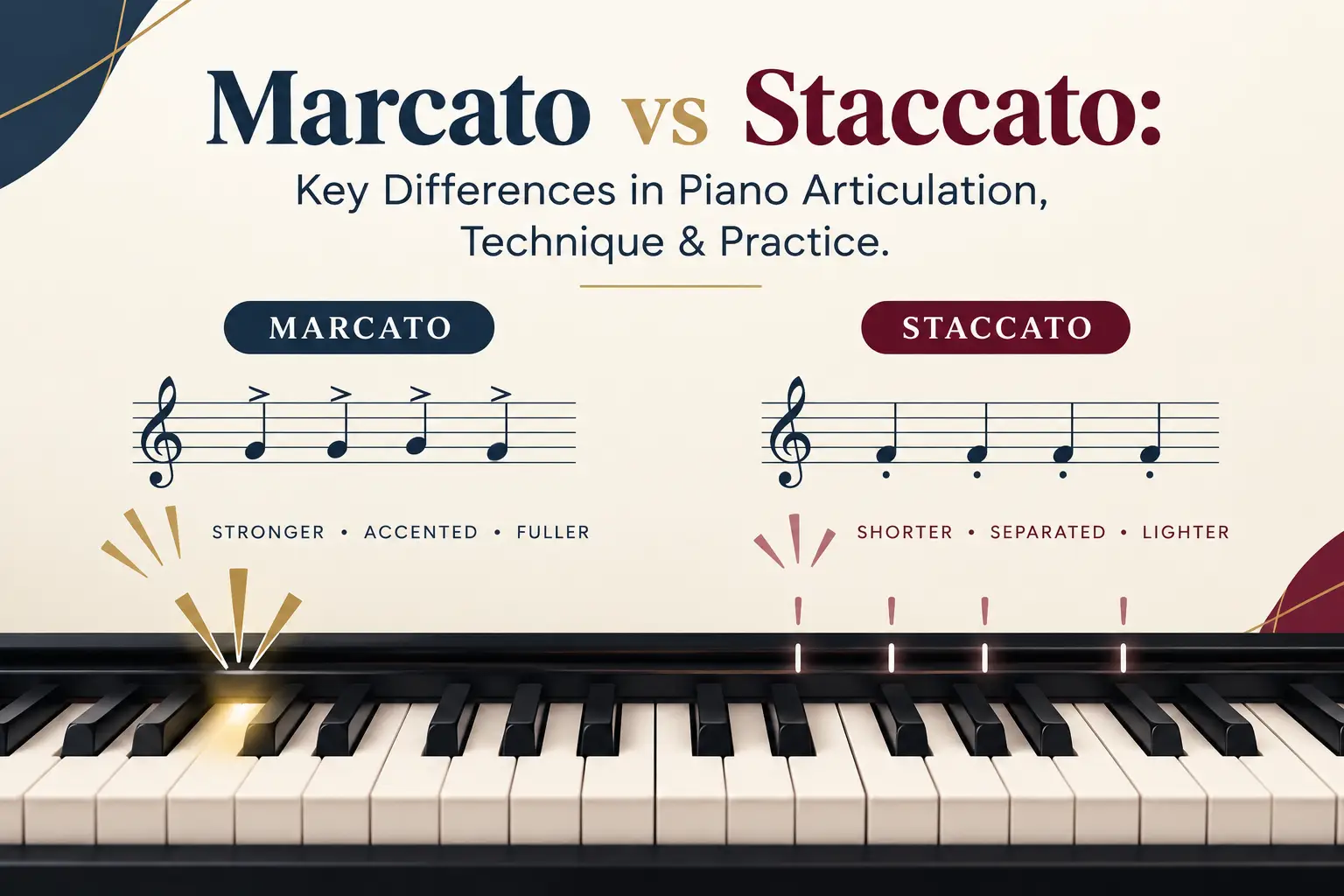
Ask a room of piano students what marcato means and someone will say “loud staccato.” I hear this a lot, and I get why. The two markings look alike on the page, and both sound a bit sharp. They’re actually asking for different things, and swapping one for the other makes the music sound flat.
So, let’s untangle marcato vs staccato and look at what your hands, wrists, and feet should be doing for each piano articulation. Legato shows up briefly too, since it’s the third touch you’ll need to tell them apart. Below you’ll find a quick chart and a few exercises to try at your next piano practice session.
Articulation Comparison Chart
| Staccato | Marcato | Legato | |
| Meaning | Short, detached | Strongly accented | Smooth, connected |
| Symbol | Dot | Wedge (^) | Curved slur |
| Note duration | About half or less | Longer than staccato, shorter than legato | Full value, no gap |
| Touch | Light, quick release | Firm, weighted | Gentle, overlapping |
| Mood | Playful | Bold | Singing |
The best way to differentiate between marcato vs staccato is to have a look at what each of them is actually communicating to us. An easy way to remember the difference: staccato is about length. Marcato is about weight. A staccato note can even be played very softly, but a marcato one hardly ever will be.
What the Markings Actually Say
These articulation markings are tiny on the page, which is partly why they get mixed up. A dot (staccato), a small wedge (marcato), or a curved line over some notes (legato). Each of them is explained the same in any music theory book: staccato (space in between), marcato (a more forceful attack), legato (chord connected under a slur)
The word marcato means “marked,” and players don’t all read it the same way. Some hear it as short and heavy. Others keep the note closer to its full value and put the punch at the start. The style of the piece usually settles it.
How to Play Staccato on Piano
How do you play staccato on piano? Light, quick, and relaxed. When it comes out heavy or jabby, tension is almost always the culprit.
Staccato note duration is usually about half the written value, or less. The rhythm still counts, though. A staccato quarter note still sits on its full beat. Part of that beat is sound and the rest is silence.
Inside the piano, a damper falls onto the string the moment you let go of a key. Staccato just lets that damper fall early, so the speed of your release is what makes the note short.
You have a few touches to choose from:
- Finger staccato for quick, light passages. Flick the fingertip up as if the key were hot.
- Wrist bounce for chords and moderate tempos. Let the wrist rebound like a ball instead of pushing it up and down.
- Forearm staccato for loud octaves and big chords.
Staccato pedaling needs a light hand. Most staccato passages want very little pedal, since it blurs the gaps, you’re trying to create. If the music asks for some color, use short, light touches.
How to Play Marcato
Marcato needs weight and clarity at the same time. Think about weight transfer from your arm into the key. Let your arm sink into the note so it sounds full and firm, then release it cleanly, usually a little before its full value. That way the next note starts fresh.
Stay loose through the wrist. Tight shoulders turn strength into banging. Picture a drumstick: a firm hit, then an immediate rebound.
This is where marcato differs most from staccato. Staccato pops off the key and disappears. Marcato digs in, states the note, and then let’s go. You’ll find it in marches, fanfare-style themes, and driving bass lines.
Where Legato Fits In
Legato is the opposite of both. The difference between staccato and legato in music is what happens between two notes. With legato, nothing does. With staccato, silence does.
The piano makes legato trickier than it sounds. Nothing inside the instrument can actually join two notes, so it’s a bit of a magic trick. Learning how to play legato on piano means timing each note so the ear hears one unbroken line.
- Overlapping fingers: Press the next key right as the last one lets go, and keep the overlap tiny.
- Weight transfer: Let arm weight travel from finger to finger, so only one finger carries it at a time.
- Finger independence: Each finger moves on its own while the rest stay loose. That’s one reason many method books wait before asking beginners for connected touch.
- Legato pedaling: Press the pedal just after playing a note and lift as you play the next one. It smooths small gaps, but it can’t fix a lumpy line.
The difference between staccato and legato also changes the mood. Staccato vs legato piano playing is like the gap between chatting in quick, bright phrases and singing one long line. You can hear staccato vs legato in music constantly, like a bouncy left hand underneath a singing right-hand melody.
When to Use Each Articulation
Articulation does more than set note length. A slur tells you where a phrase begins and ends, staccato can sharpen the rhythm of a dance, and marcato adds weight that changes how loud a passage feels. All of that feeds into interpretation, which is really just the choices you make about character.
Staccato suits playful or nervous moods. Marcato gives a theme authority and drives the rhythm forward. Legato belongs with lyrical melodies and slow, expressive music. Composers often mix them in one phrase, like a melody that glides along in legato and ends on a single staccato note, almost like a comma.
Part of it is style. (There’s a reason Baroque staccato is a lot drier than Romantic staccato.) You can learn from music theory what a particular marking indicates, but a lot will be learned from what your ear and the style of the music suggest. If the passage has no markings at all, try it several ways at your next piano lessons.
Staccato and Legato Exercises for Daily Practice
These staccato and legato exercises double as simple piano technique exercises, and the whole set takes about ten minutes. Start with a short warm-up so your shoulders and wrists feel loose before you ask them to bounce or dig in.
- Single-note staccato. Pick one note and repeat it, switching fingers each time. You’re after a short, even sound and a wrist that stays relaxed.
- Wrist bounce on chords. Play a repeated chord staccato and let your wrist rebound softly after each one, like a ball on a floor.
- Marcato steps. Take a five-finger pattern and play each note with firm weight, then a small lift. The tone should be full, not harsh.
- Two-touch contrast. Play four notes staccato, then the same four marcato, changing only your touch. This is where the marcato vs staccato contrast becomes something you can actually hear.
- Legato reference. Play that pattern slowly with no gaps. Then try the right hand legato while the left plays staccato. It’ll feel awkward, and that awkwardness is finger independence being built.
Give each exercise a few days before you speed up. Progress here comes in small, steady steps, and adding tempo or volume before the sound is clean just locks in sloppy habits. If you can, record a minute of it on your phone. Your ears catch things your hands don’t.
Common slip-ups to watch for:
- Lifting the whole arm for staccato instead of letting the wrist or fingers rebound
- Holding the pedal down through a staccato passage
- Playing marcato with tight shoulders and a pounding wrist
- Treating every slur as permission to blur the notes
Final Thoughts
Marcato and staccato share a page, but they don’t share a job. One is about lightness and the other is about weight, and legato sits in the background as the thing they both push against. When a passage sounds off, ask yourself two questions: how long should this note last, and how heavy should it feel? The answers usually point you straight to the right touch.
Try it on a piece you’re already learning. Find the dots and wedges, play them as written, then exaggerate the difference so you can really hear it. Pull back a little once it feels natural. If something still feels stuck, or your wrist keeps tensing up, a vocal teacher can spot the problem in a few minutes. That’s where piano lessons earn their keep.
FAQs
Is marcato the same as staccato?
Not quite. Staccato is about keeping a note short and light. Marcato is about giving it weight and a clear attack. Marcato notes are often a little separated too, which is why the two get confused, but the emphasis is what defines it.
Is marcato always louder than staccato?
Most of the time. Marcato usually carries more attack and weight, while staccato can be played whisper soft. That said, the dynamics in the score always win, so a soft marcato is possible when the music asks for it.
How short should staccato notes be?
Around half the written value is a good starting point, sometimes less. Tempo and style change the answer. A quick Mozart passage wants a lighter, drier sound than a slow, dramatic Romantic one.
Can I use marcato and staccato in the same phrase?
You can, and composers do. Just make sure your hand feels the switch: a light, quick release for staccato and a weighted attack for marcato.
Do I need the pedal for staccato or marcato?
Usually very little. Pedal blurs the gaps in staccato, and marcato sounds clearest when you use it sparingly. A touch of color is fine when the music calls for it.
Should I learn legato or staccato first?
Most teachers begin with legato because it builds finger control and a relaxed hand. Add staccato once your hand stays loose, then practice switching between the two.
