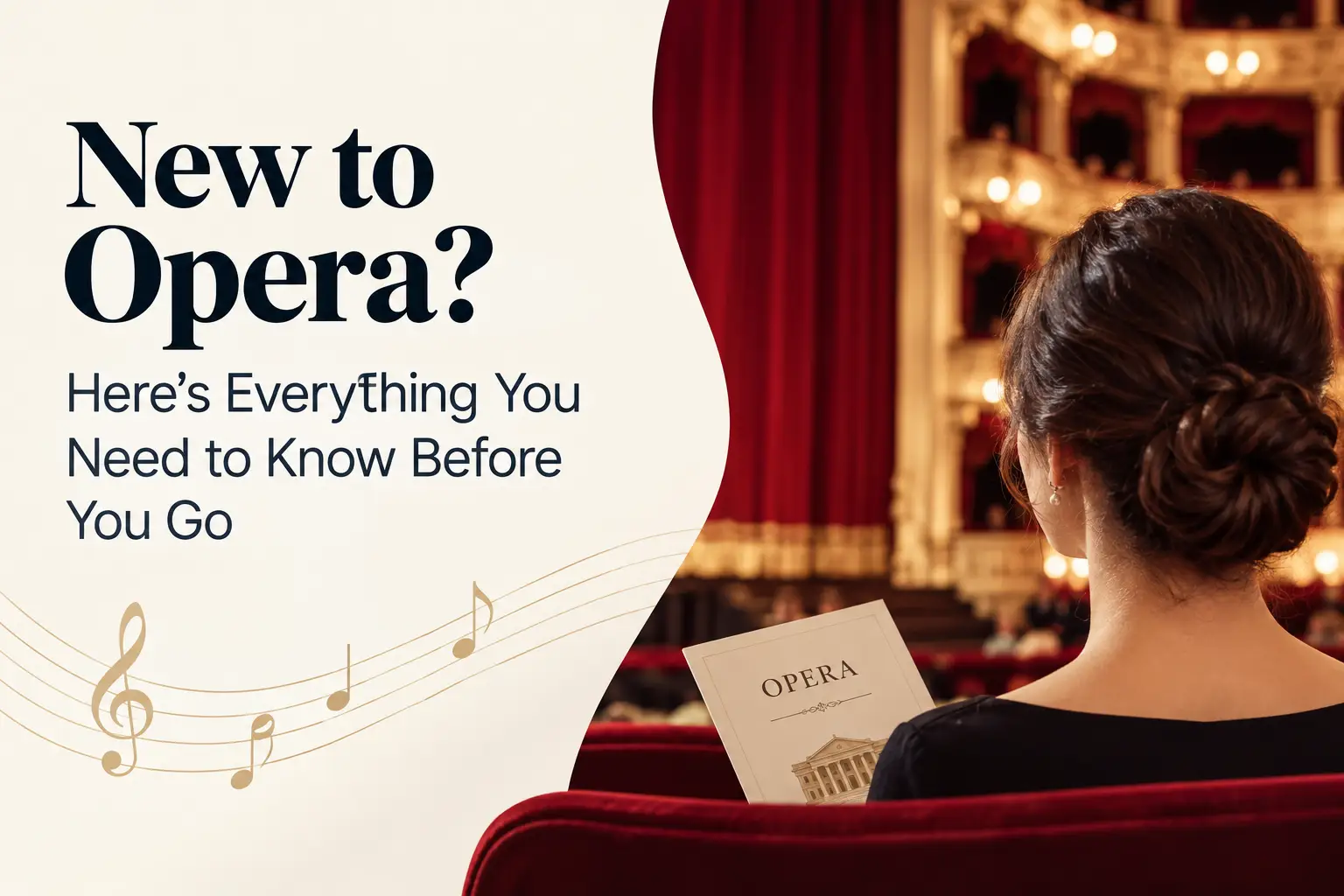
You’ve found an opera performance that looks interesting. Then the questions begin: Will you understand the story? Is there a dress code? When are you supposed to clap?
The good news is that you don’t need to study music before your first show. This opera for beginners guide covers what you’ll see, what you’ll hear, and what to check before booking.
What is Opera?
Opera tells a story through music and theatre. Singers play characters, an orchestra performs the score, and sets, costumes, and lighting bring the action to life. Some operas are funny, some are tragic, and many move between the two.
The clearest way to picture it is a play in which music carries much of the dialogue and emotion. A character might take a moment to say something simple, then sing for several minutes about what it means to them. You can follow the action without knowing the technical terms, but a few words will help when you read a programme:
| Term | How to pronounce it | What it means |
| Libretto | lih-BRET-oh | The words sung in an opera: its text or script. |
| Overture | OH-ver-cher | An instrumental opening played before the staged action in operas that have one. |
| Recitative | reh-sih-tuh-TEEV | Singing that follows the rhythm of speech and often moves the story along. |
| Aria | AR-ee-uh | A song-like passage that gives a character space to express a feeling or thought. |
So, what is an aria in opera? Think of it as a moment when the action slows and you hear what matters to a character.
What is recitative in opera? It often handles the conversation around those moments. If you’re wondering what is a libretto, it’s the opera’s written text.
And what is an overture in opera? It’s the musical introduction, when the opera includes one.
Do I Need to Understand Italian?
No. Opera is performed in many languages, and you can enjoy the singing and acting without speaking the one used onstage. Many venues display translated text above the stage or near your seat. These translations are often called surtitles or titles.
Before you buy a ticket, check the production page for its performance language and title language. Some companies perform operas in translation; others keep the original language and provide titles. Arrive early enough to find the display from your seat.
What happens if you don’t understand the language? Read a short plot summary beforehand, follow the titles when you need them, and look back at the performers. You don’t have to catch every line to understand that someone is pleading, celebrating, or making a terrible decision. The English National Opera’s beginner’s guide is a useful starting point for getting familiar with the experience.
How Can A Beginner Visualize Opera Singing?
Imagine singing a line while an orchestra plays beneath you and someone at the back of a large room needs to hear the story. Opera singers train to make their voices carry and to express a character through sound. If you’re interested in developing your own voice, Singing Lessons can also help you understand the vocal techniques behind controlled, expressive singing. The orchestra isn’t background music: it can build tension, signal a change of mood, or tell you something a character hasn’t said aloud.
You’ll hear different types of opera singing across a performance. One passage may sound close to conversation; another may stretch a single feeling into an aria. Sometimes several characters sing at once, each reacting differently to the same event. You don’t need to separate every word. Watch who moves toward whom, listen for changes in the music, and use the titles to catch the turning points.
What Are Operatic Vocal Ranges?
Opera uses voice classifications to help match singers with roles. The familiar higher voice types include soprano, mezzo-soprano, and contralto; others include tenor, baritone, and bass. These operatic vocal ranges overlap, so a singer isn’t classified by one high or low note alone.
You may notice how a higher voice cuts through a busy scene or how a lower voice gives a line a different weight. Treat those sounds as part of the storytelling. Knowing the labels is optional on your first night; hearing how two characters sound together is much more fun.
Famous Opera Singers to Listen to Before You Go
Listening to one or two singers can help you get used to operatic voices. Start with a short performance clip, then listen for the character behind the sound.
- Renée Fleming is a celebrated soprano known for a wide repertoire. The Hong Kong Philharmonic’s introduction to Fleming shows how her programmes move across different kinds of music.
- Joyce DiDonato is a mezzo-soprano admired for the range of characters she portrays. In a Guardian interview, she describes the variety of roles available to mezzos, including princesses and witches.
- Marian Anderson was a contralto whose artistry and career made her a historic figure in American music. PBS’s biography explains both her singing career and the barriers she overcame.
- Roberto Alagna is a tenor known for operatic roles and a long stage career. Le Monde’s profile describes his path into opera and the roles he has taken on.
They’re famous for more than the notes they can reach. Each has brought a distinct musical voice and presence to the stage. As you listen, ask yourself what you understand about the character before reading the translation.
How Do I Choose My First Opera?
Start with a story that appeals to you. If you like comedy and quick-moving misunderstandings, read the synopsis of a comic opera. If you prefer a dramatic love story, look for one, but check whether you’re in the mood for a tragic ending.
Then look at the production page. It should help you answer four practical questions: How long is it? Is there an interval? What language is sung? Are translated titles provided? Some operas last around two hours; others take considerably longer. The running time listed by the venue is more useful than a general rule because productions and intervals vary.
When searching opera performances near me, use the websites of local opera companies and theatres. A performance might be staged with full sets and orchestra, presented in a smaller venue, or shown as a cinema screening. Check the format so you know what you’re booking.
What Should I Wear to the Opera?
Wear something comfortable for sitting through the performance. Many audiences include people in everyday clothes alongside people who’ve dressed up for the occasion. If you want to make an evening of it, you can dress up; you don’t need a gown or tuxedo as a default.
Dress rules depend on the venue and event, so check your ticket or the opera house’s visitor page before you go. A gala or a particular theatre may have specific requirements. That makes the venue’s own guidance a more dependable opera house guide than a blanket dress-code rule.
Opera Etiquette Without the Guesswork
These opera tips for beginners cover the moments most likely to make you hesitate:
- Arrive with time to spare. You can find your seat, locate the titles, and read the short synopsis.
- Silence your phone and put its screen away during the performance. Check the venue’s photography rules.
- Keep conversation for the interval. Even a whisper can distract someone nearby during a quiet passage.
- Follow the room when applauding. Applause often follows a major aria or the end of an act. It’s fine to wait a second and join in.
- Plan for the interval. Check whether there is one, especially before a longer performance.
If you arrive late, ask an usher when you can enter. The venue may seat you at a suitable break rather than during a scene.
The most useful piece of opera etiquette is simply to give the performers and the people around you your attention. You don’t need to react at the “correct” moment or understand every musical choice. Pick a story you’re curious about, check the practical details, and let your first opera surprise you.
