
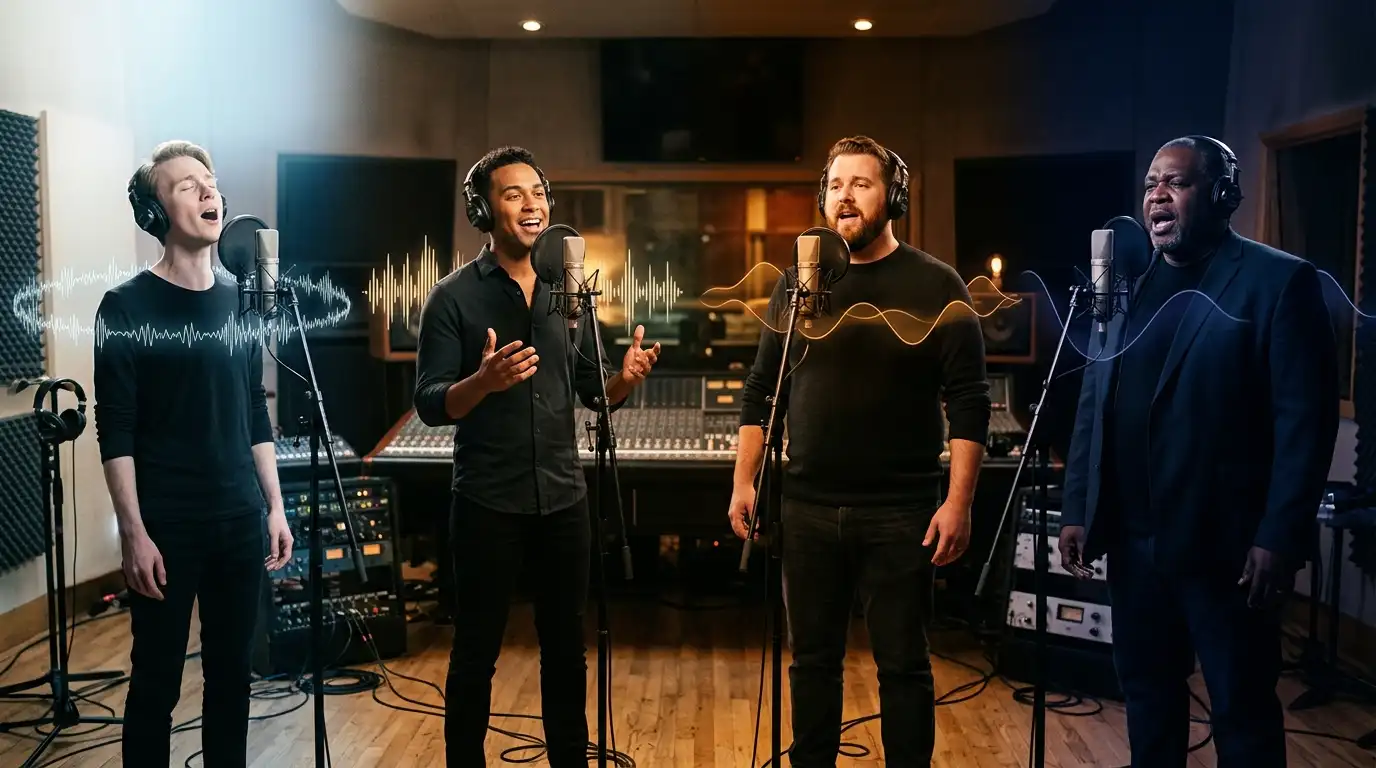
Most male singers have no idea what their actual voice type is.
They sing the songs they like, hit the notes they can reach, and never really think about where their voice sits. That works for a while. But knowing your male vocal types changes how you train, what you sing, and how fast you improve.
Here is a plain breakdown of every main male voice type and how to figure out which one you are.
What Is the Male Voice?
After puberty, the larynx grows, and the vocal cords lengthen. That is what drops the pitch. It is also what creates the distinct qualities of the male voice that separate it from female voices so noticeably.
The main qualities of the male voice are depth, warmth, and resonance. Even the highest male voice type sits lower than most female voices. That physical difference shapes everything about how male voices get classified and trained. Male voice classification in singing comes from classical and choir tradition, where voices get divided into categories based on range and tone color.
How Many Male Voice Types Are There In Singing

Four. Tenor, baritone, bass, and countertenor.
Those are the main singing voice categories male singers fall into. In opera and formal choir singing settings, you will find subcategories like lyric tenor or dramatic baritone. But the four main types of male voice are what matter for most singers, figuring out where they sit.
Tenor
Tenor is the highest standard male voice type.
A typical tenor sings from around C3 to C5. Bright tone, clear upper register, comfortable in the high notes without forcing them. In choir singing, tenors carry the melody. In opera, they get the big dramatic moments.
Luciano Pavarotti is the most famous classical tenor that most people can name. Freddie Mercury had strong tenor range too, which is a big part of why his voice felt so alive in Queen recordings.
What makes a tenor:
- Bright and forward in tone
- Strong upper register without strain
- Comfortable sitting high in the mix
Baritone
Baritone is the most common male voice type. Most male singers land here.
The baritone vocal range runs roughly from G2 to G4. Warmer and fuller than a tenor. Not as deep as a bass. Lots of flexibility between the two extremes.
Elvis Presley was a baritone. Frank Sinatra was a baritone. Both built their entire sound around that warm midrange rather than fighting to hit tenor notes.
What makes a baritone:
- Warm, centered tone in the middle register
- Strong across a wide range of materials
- The default male singing voice type in pop, rock, and country
In modern music, the baritone is where most male vocal ranges naturally sit. If you feel comfortable in the middle and find very high notes forced, this is probably you.
Bass
Bass is the lowest of the male vocal types.
A bass vocal range runs from around E2 down to C2 or lower. Deep, dark, heavy. In choir singing, the bass section is the harmonic foundation everything else sits on. In opera, bass roles tend to play authority figures or ancient characters because of the weight that low voice carries.
Johnny Cash is the most recognizable bass-leaning voice in modern music. That low resonant tone became one of the most iconic sounds in American music history.
What makes a bass:
- Deep and dark in tone
- Most comfortable in the lower register
- Not built for high notes but incredibly strong in the right range
Countertenor
Countertenor is the rarest male voice type. Most male singers never develop it.
A countertenor sings primarily in the alto range using trained falsetto or a naturally high male voice. The range can reach from G3 up to E5 or higher. In classical music and opera, countertenors perform music originally written for castrato singers in the Baroque era.
What is the rarest male voice type? This is it. It sits completely outside the typical tenor baritone bass framework that most vocal classification male singers work within.
Male Vocal Range Chart
Here is a quick reference showing lowest to highest male voice types.
| Voice Type | Approximate Range | Tone |
|---|---|---|
| Bass | E2 to E4 | Deep, dark, resonant |
| Baritone | G2 to G4 | Warm, full, centered |
| Tenor | C3 to C5 | Bright, clear, forward |
| Countertenor | G3 to E5 | Light, high, falsetto-based |
Range alone does not determine your voice type. Tessitura, where your voice sits most comfortably, matters just as much as your extreme notes.
Tenor, Baritone, Bass Explained
The difference between tenor, baritone, and bass comes down to three things. Range, tone, and where the voice sits naturally.
Tenors are bright and high. Basses are dark and low. Baritones sit between them with more warmth than a tenor and more flexibility than a bass. Most vocal range types of male singers fall into the baritone because that middle ground is where most male voices naturally live.
Classical vs Modern Male Voice Types
Classical male voice types follow strict range and tone requirements set by the vocal classification system used in opera and formal choral settings. A tenor in opera must hit specific notes in a specific way, or the classification does not apply.
Modern male voice types are more relaxed. Tone, color, and stylistic fit matter more than strict categories. Andrea Bocelli is a good example. Trained as a classical tenor but with baritone warmth in certain registers. That crossover quality is part of why his appeal is so wide.
Which male voice type is best for singing? Genuinely depends on what you are singing. Every type has strengths. Tenor sits in pop and operatic leads. Baritone covers the widest range of modern material. Bass brings a depth that nothing else replicates. A countertenor fits specific classical repertoire better than anything else.
How to Identify Your Male Voice Type

Most singers test their voice type by going for extreme notes. That is the wrong way to do it.
Your voice type is about where you sit naturally, not what you can force at the edges.
How to figure out your voice type:
- Sing in the middle of your range and notice where things feel open and easy
- Find your most comfortable speaking pitch, it usually sits near your vocal center
- Notice where your voice shifts or breaks, transition points give you real information
- Record yourself and listen back, your natural tone tells you more than extreme notes do
What vocal range do most male singers have? Baritone. If the middle feels easy and the top feels forced, that is your answer.
Starting With the Right Training
Knowing your voice type is step one. Building it is the ongoing work.
Different male singing voice types need different approaches. A bass working on chest resonance has completely different priorities than a tenor developing head voice. Generic advice misses that entirely.
If you want to start at your own pace, an online singing course built around vocal fundamentals gives you a structured starting point regardless of where your voice sits.
One-on-One Work
Your voice type is specific to you. The tessitura, the tone, the breaks, the strengths. All of it belongs to your individual instrument.
Private singing classes give you direct work on your actual voice rather than general instruction that may or may not apply to your specific vocal classification.
Getting an Accurate Read
Singers misidentify their voice type on their own all the time. Usually they aim too high or underestimate how low they can comfortably go.
Working with an experienced vocal coach in Mountain View California gives you an accurate read on your male vocal types and a clear direction for developing from where you actually are.
To Wrap It Up
Tenor, baritone, bass, and countertenor are the four main male vocal types. Most male singers are baritones. Some are tenors. Fewer are true basses. Countertenors are rare.
Knowing which one you are is not a limitation. It is a starting point. The right training from there takes you further than ignoring your voice type and just hoping for the best.
FAQs
What are the main male vocal types?
Tenor, baritone, bass, and countertenor. Tenor is highest, bass is lowest, baritone is most common, countertenor is rarest.
How do I know my male voice type?
Sing in your comfortable middle range. Where things feel easiest and most natural is your tessitura. That tells you more than your extreme high or low notes ever will.
What is the most common male voice type?
Baritone. Most male singers land here whether they identify it that way or not.
What is the rarest male voice type?
Countertenor. It requires significant training and a naturally high male voice. Most male singers never develop this range.
Can your voice type change?
Not significantly after full physical maturity. Training extends your range and improves how you use your voice but your fundamental voice type stays largely the same.
