
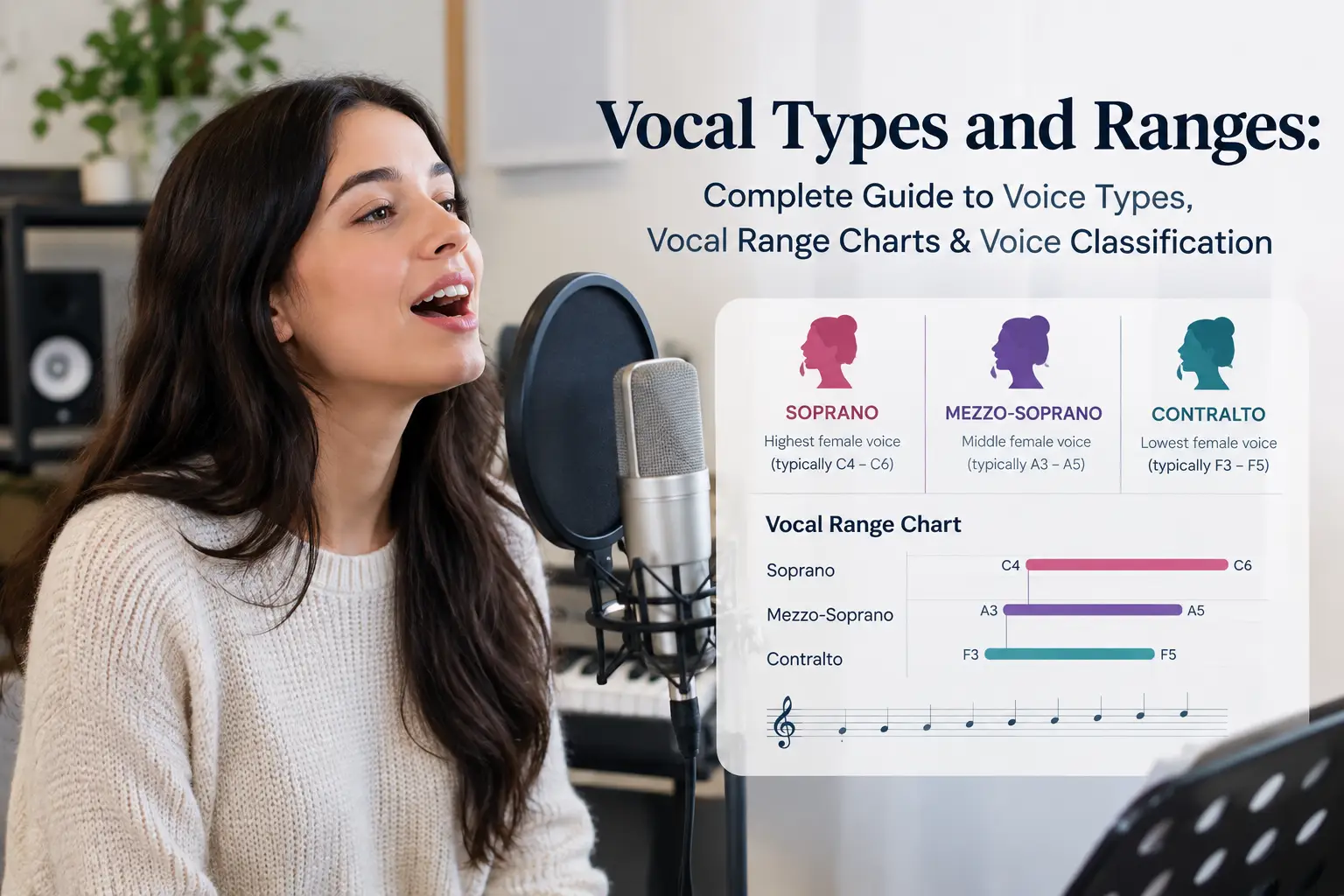
You reach the highest note in a song and wonder, Does that make me a soprano or a tenor? It’s a fair question, but one note can’t identify your voice type. The notes you can sing comfortably through a whole song matter just as much.
This guide explains vocal types and ranges, shows how to read a vocal types chart, and helps you test your range. You’ll also meet famous singers whose established voice classifications give the chart a sound you can listen to.
What Is A Vocal Range?
Your vocal range runs from the lowest to the highest note you can produce. Notes are written with a letter and number. C4 is middle C on a piano; C5 is one octave above it, and C3 is one octave below.
It helps to distinguish your full range from your usable range. You might briefly reach a very high note, but if you can’t sing it clearly or repeat it comfortably, it may not be useful in a song. The area where your voice feels most at home is called your tessitura.
Vocal Types Chart: A Beginner’s List of Vocal Ranges
This list of vocal ranges shows six traditional classical voice types. Each range is approximate. The categories overlap, and singers don’t need to match both endpoints to belong to a type.
| Voice type | Approximate range | General position |
| Soprano | C4-C6 | Higher voice |
| Mezzo-soprano | A3-A5 | Middle voice |
| Contralto | F3-F5 | Lower voice |
| Tenor | C3-C5 | Higher voice |
| Baritone | A2-A4 | Middle voice |
| Bass | E2-E4 | Lower voice |
Use this as a vocal range comparison chart, especially if you’re new to note names. A vocal range chart with piano keys makes the overlap easy to see: several voice types can sing middle C, for example. Their classification depends on more than whether they can reach it.
A vocal range chart for females traditionally includes soprano, mezzo-soprano, and contralto. A vocal range chart for males traditionally includes tenor, baritone, and bass. These are conventions used heavily in classical singing. A person’s gender alone doesn’t tell you which notes they can sing.
You may see alto in place of contralto on a vocal range chart for beginners. Alto usually means a lower choir part, while contralto names a classical solo voice type. Someone assigned the alto part in a choir might be a mezzo-soprano.
Famous Singers Across the Voice Types
Listening to established singers can make the chart more meaningful. These examples come from performance organizations, artist sources, and biographical reporting, rather than guesses based on a singer’s highest recorded note.
| Voice type | Singer | What to listen for |
| Soprano | Renée Fleming | Listen to how comfortably her voice carries sustained higher phrases. |
| Mezzo-soprano | Joyce DiDonato | Notice the strength and expression she brings to her middle register. |
| Contralto | Marian Anderson | Hear how naturally her voice settles into lower passages. |
| Tenor | Roberto Alagna | Listen for ease through extended high writing, beyond a single high note. |
| Baritone | Benjamin Appl | Pay attention to the color and clarity of his middle range. |
| Bass | René Pape | Hear the weight and presence of his lower voice. |
These singers are examples of singing voice types, not exact recordings of the chart’s endpoints. Don’t assume Fleming always sings C4-C6 or that Pape never sings outside E2-E4. Listen instead for where each singer can sustain phrases and shape the music.
How Does Your Voice Make Different Notes?
Inside the larynx, two vocal folds, also called vocal cords, vibrate as air passes through them. Changes in their vibration help produce different pitches. The sound is shaped further as it travels through the throat and mouth.
Pitch isn’t the only quality you hear. Resonance helps give a voice its color and fullness. Vibrato is a gentle, regular variation you may hear when a singer holds a note. Neither one identifies a voice type on its own.
Chest Voice, Head Voice, Falsetto and Other Registers
As you sing from low to high, your voice may change in sound and sensation. Singers and teachers use several terms to describe those changes:
- Chest voice often describes a fuller sound used on lower notes.
- Head voice often describes a lighter sound associated with higher notes.
- Mixed voice is a teaching term for a sound with qualities associated with both chest and head voice.
- Falsetto commonly describes a lighter upper-register sound. Teachers may explain its relationship to head voice in different ways.
- Whistle register produces exceptionally high sounds. You don’t need it to identify your everyday singing range.
- Vocal fry is a low, creaky sound. A note made only with fry may not be part of your usable range.
How to Take A Useful Vocal Range Test
A vocal range finder or piano app can identify your pitches, but it can’t decide which ones feel good to sing. Try this simple vocal range test:
- Warm up gently with an easy hum or familiar melody.
- Match a comfortable note on a piano or keyboard app.
- Move down one note at a time. Stop when your sound becomes unclear or you need to strain.
- Return to your starting note and move upward. Stop before you have to squeeze or shout.
- Record your clear, repeatable notes. Keep notes reached only with fry or whistle register separate.
- Sing a short song. Notice which stretches feel easy across whole phrases.
Try another day again if your voice feels tired. A test captures what you did at that moment; it isn’t a permanent limit.
How to Determine Your Voice Type
Compare your usable notes with the chart, then pay closer attention to your tessitura. Can you sing several phrases in that area comfortably? Does your tone stay clear? Can you focus on expression instead of working to reach every note?
If two categories seem possible, that’s ordinary. A mezzo-soprano and soprano may share many notes; so, may a tenor and baritone. Joann C. Chang, a vocal instructor, can help you hear how your voice behaves across different songs and keys if you want a more informed classification.
What is the Average Vocal Range?
There’s no single average vocal range that fits everyone. Many voice charts show roughly two octaves for each type as a convenient guide, but individual singers vary. The total also changes depending on whether someone counts faint extreme notes, vocal fry, falsetto, or whistle register.
How many octaves can a human sing? Again, there’s no number that describes every person. More octaves don’t automatically mean better singing. A clear, expressive song within a modest range is more valuable than a collection of extreme notes you can’t use comfortably.
Let the chart help you find a starting point. Then listen to how your voice handles real music. That’s where a voice type becomes useful.
