
Nobody talks about the first ten minutes of a performance being rough. But ask any singer honestly, and they’ll tell you. The voice takes time. You open your mouth on the first song, and it’s not quite there yet; consonants are soft, the tongue feels slow, and by the second song, things finally click.
That gap is almost always about what didn’t happen before walking on stage. Vocal warm up tongue twisters are one of the most skipped parts of prep and one of the ones that actually matters. Not because they’re fun to say fast, though some of them are, but because they wake up the specific muscles that make diction work. Five minutes. Real difference.
Why Do Singers Use Tongue Twisters?
Your breath and pitch get a lot of attention in vocal training. Your articulators, meaning the lips, tongue, teeth, and jaw, usually don’t. That’s the gap tongue twisters fill.
Singing fast with clean consonants is a physical skill. Ariana Grande’s diction at full tempo doesn’t happen by accident. Neither does Beyoncé’s. Both are known for crisp, clear delivery even when the notes are stacked, and the pace is relentless. Articulation exercises for singers train those muscles the same way a runner trains their legs. Speech therapy has used twisters for years. Elocution training, too. There’s a reason.
How Long Should Vocal Warm Ups Be?
Somewhere between 10 and 20 minutes is the standard. You don’t need all of that to be twisters. Five solid minutes of twister work inside a singing warm up routines is genuinely enough. The thing most people get wrong is speed. They go fast immediately. Go slow first. Always. Fast comes after slow feels easy.
How To Warm Up Voice Before Singing
Two minutes of breathing before anything else. Belly drops on the inhale, no chest rising, no forcing the exhale. Then hum. Find a comfortable pitch and sit there until the vibration shows up in your face and sinuses. That resonance is the signal your cords are awake.
Then move into vocal warm up phrases on a single pitch. Then twisters. That order matters. Cold twisters are like cold sprints. You can do them. They just won’t do what you need them to do.
The Best Vocal Warm Up Tongue Twisters for Singers
Here’s what actually works and why each one is worth your time.
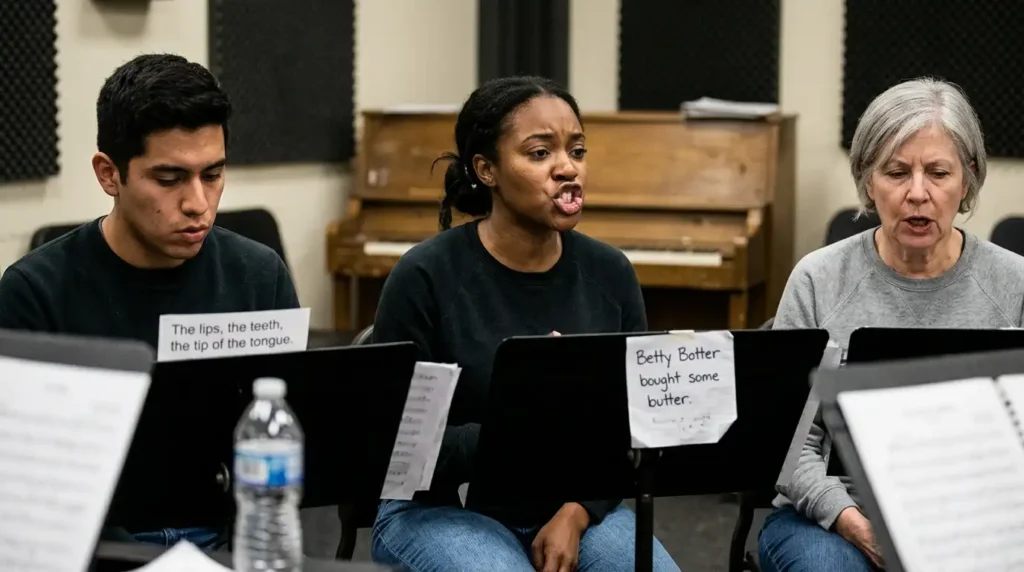
- “The lips, the teeth, the tip of the tongue.” This one’s been used in opera singing for a long time, and it holds up. It targets the front of the mouth directly and gets lip closure, tooth placement, and tongue tip working before anything harder. Five times slow. Five times faster. That’s it.
- “Red leather, yellow leather” Ten reps without stopping. The L, R, and TH in this phrase demand constant tongue repositioning. It’s one of the better voice training tongue twisters for singers who want to improve pronunciation singing, especially in songs where the lyrics move quickly and the consonants stack up.
- “Peter Piper picked a peck of pickled peppers.” Those P sounds push air forward and force hard lip closure on every hit. Freddie Mercury had punchy, precise consonants. Michael Jackson, too. That quality isn’t a coincidence. It’s trained. This twister builds the same muscle habit. Exaggerate the P sounds first, then add speed.
- “She sells sea shells by the seashore.” S and SH are genuinely hard in choir singing. When multiple singers hit that consonant at slightly different times, it turns into a blur. This twister isolates exactly that challenge. It’s also one of the better clear singing pronunciation practice tools for solo singers recording in the studio, where sibilance problems show up fast on playback.
- “Betty Botter bought some butter.” B and T in quick alternation. A lot of singers swallow the T at the end of words or let B sounds go soft. Both habits show up clearly in recordings. This one directly addresses that.
- “Unique New York, you know you need unique New York.” Vowel clarity and N and Y coordination together. The Beatles sang with clean, open vowels even at pace, which is a big part of why their lyrics are so easy to understand. This is one of the more underrated vocal warm up tongue twisters for adults. It’s harder than it sounds, and it doesn’t feel like a children’s exercise.
- “How much wood would a woodchuck chuck?” W and CH sounds need breath and the mouth to move together. Singing diction exercises that connect articulation to breath control are the ones that translate most directly into real performance situations.
Tongue Twister Warm Ups for Choir
In a group, diction is everyone’s problem at once. One person landing a consonant late drags the section with them. Tongue twister warm-ups for choir work best when the director takes the group through them in unison, slowly, before bumping the pace. Every mouth at the same moment is the whole objective.
Practicing at Home and Actually Improving
Pick two or three from this list. Do them every day for two weeks before adding anything new. Record yourself each time on your phone. Listening back is genuinely the most useful thing you can do because most singers can’t accurately hear their own diction from inside their head.
Twister works well with broader vocal training, too. If you’re also trying to extend your range, the how to improve vocal range guide covers the vocal warm up exercises that work best alongside this kind of daily articulation routine. And once your diction feels solid, how to improve vocal projection is the next logical step, because clear consonants that don’t carry to the back of the room only solve half the problem.
Working With Someone Who Can Actually Hear You
Here’s the honest issue. You can’t objectively hear yourself. What feels crisp inside your head regularly sounds muddy to everyone else in the room. Private singing classes put someone in front of you who hears exactly what you’re producing and can tell you what to fix right then. For a warm up routine that’s actually built around your voice specifically, an online vocal coach in Mountain View California can put that together with you rather than you piecing it together from general advice.
To Wrap It Up
Vocal warm up tongue twisters belong in your routine. Not as a warmup curiosity but as real vocal agility exercises that prepare your mouth for actual performance demands. Take two or three from this list, go slow, record yourself, build speed over days, not minutes. The improvement in your consonants and diction shows up faster than most singers expect.
FAQs
What are vocal warm up tongue twisters?
Phrases with repeated or tricky sound combinations that are hard to say quickly and clearly. Singers use them before rehearsals and performances to activate the muscles involved in articulation.
How do tongue twisters help singers?
They get the lips, tongue, and jaw moving fast and precisely before you sing. That directly improves diction, consonant clarity, and the kind of breath-to-articulation coordination that shows up in real performance.
How to improve diction in singing?
Consistent practice with articulation exercises for singers is the main route. Twisters, recording yourself regularly, and getting feedback from someone who can hear what you’re actually producing all make a real difference.
What are good vocal warm ups for beginners?
Breathing first, then humming on a comfortable pitch, then simple vocal warm up phrases on one note. Once that feels easy, add a simple twister like “the lips, the teeth, the tip of the tongue” and keep the pace slow until the words come out clean.
