

If you have ever listened to a singer and found yourself struggling to catch the words, diction was likely the problem. Good diction in singing is what separates a technically gifted vocalist from one who truly connects with an audience. When every word lands clearly, the story gets told. When it does not, even the most beautiful voice falls short.
So what exactly is diction in singing? Let us break it down.
What Is Diction in Singing?
Why Is Diction Important in Singing?
The short answer: because lyrics matter.
Whether you are performing a heartbreaking ballad or an upbeat pop song, the words you sing carry the emotional weight of the piece. Bad diction turns those words into mush. Good diction makes them land like punches.
Here is why diction is important in singing beyond just being understood:
It tells a story. Songs are miniature narratives. When your pronunciation is clear, the audience follows every twist and turn. When it is not, they disengage.
It shows musicianship. Singers who pay attention to consonants and vowels sound more polished and professional. Judges, directors, and audiences notice.
It affects resonance. The shape of your mouth and jaw directly influences vocal resonance. Open, well-formed vowels produce a richer, fuller tone. Lazy vowels restrict the sound.
It builds connection. When people understand every word you are singing, they feel like you are speaking directly to them. That is what great storytelling sounds like.
What Makes Good Diction in Singing?

Good diction in singing comes down to three things: vowel clarity, consonant precision, and breath support. These three elements work together to keep your voice clear and strong.
Vowel Clarity
Vowels carry the tone in singing. Most of the sustained, resonant notes you sing land on vowels. This means how you shape a vowel directly affects how your voice sounds.
In classical training, singers use the International Phonetic Alphabet (IPA) to map out exact vowel shapes for different languages. Even if you are not studying opera, the principle applies. Open, consistent vowel shapes produce cleaner, more resonant singing.
Try holding the word “love” on a long note. Notice how the “uh” vowel feels in your mouth. Now try pinching that vowel or making it too bright. The tone changes instantly. Vowel modification is a real technique used by trained singers to keep the voice balanced across their range.
Consonant Precision
Consonants frame the words. They tell your listener where one word ends and another begins. Sloppy consonants cause lyrics to run together into one long, unintelligible blur.
There are two types of consonants to think about: voiced and unvoiced. Voiced consonants (like B, D, G) carry pitch. Unvoiced consonants (like P, T, K) are percussive and need to be clipped and precise without breaking the flow of sound.
One key trick: place initial consonants slightly ahead of the beat. This keeps the vowel on the musical pulse rather than the consonant cutting into it.
Breath Support and Breath Control
You cannot have clear diction without proper breath support. When breath runs out mid-phrase, vowels collapse and consonants get swallowed. Consistent airflow holds the sound open and keeps each word crisp.
Work on your breath control and the clarity of your singing will follow naturally. A supported tone is an open tone, and an open tone means better pronunciation across the board.
Vocal Exercises to Improve Your Diction
Improving diction is not complicated, but it does require consistent practice. Here are some practical vocal exercises that work:
Lip trills. Run scales or melodic phrases on a lip trill. This loosens tension in the lips and jaw, which is often where tight diction comes from. Relaxed lips move more freely and form consonants with less effort.
Tongue twisters. Classic for a reason. “Red lorry, yellow lorry” or “She sells seashells” push your tongue and lips to move quickly and precisely. Start slow, increase speed gradually, and always prioritize clarity over pace.
Jaw relaxation exercises. Drop your jaw fully and let it hang. Massage the jaw hinge. A tight jaw is one of the most common causes of muddy diction. When the jaw is free, vowels open up and the tongue has space to do its work.
Exaggerated enunciation. Practice songs by overemphasizing every consonant and over-opening every vowel. It will feel ridiculous. That is the point. When you bring it back to normal singing, the muscle memory carries the precision without the exaggeration.
IPA transcription. Pick a song in your repertoire and write out the phonetics. This forces you to think about every sound intentionally instead of just running on autopilot.
Stylistic Diction Across Genres
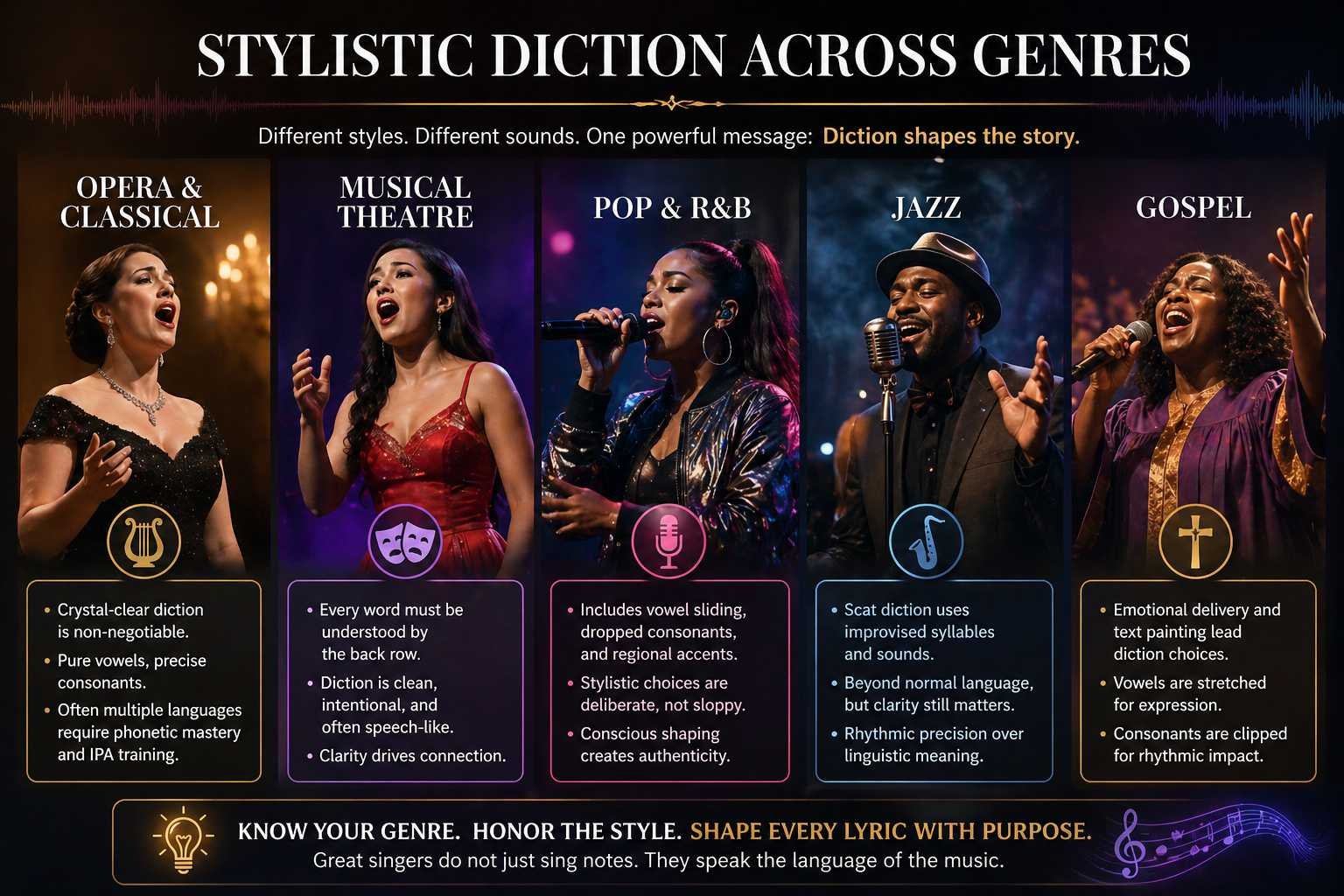
One important thing to understand is that diction is not the same in every genre. Each musical style has its own approach to pronunciation, and matching that style is part of sounding authentic.
Opera and classical. Crystal-clear diction is non-negotiable. Pure vowels, precise consonants, and often multiple languages mean singers train intensively on phonetics and IPA.
Musical theatre. Every word must be understood by the back row. Diction in musical theatre is clean, intentional, and often pushed toward speech-like delivery.
Pop and R&B. Stylistic diction here includes vowel sliding, dropped consonants, and regional accents used deliberately as artistic choices. The key word is deliberate. It is not sloppy singing. It is conscious stylistic shaping.
Jazz. Scat diction introduces improvised syllables and sounds that exist outside normal language. Clarity still matters, but it is about rhythmic precision over linguistic meaning.
Gospel. Emotional delivery and text painting drive the diction choices. Singers stretch vowels for expression and clip consonants for rhythmic impact.
Understanding which genre you are singing in shapes how you approach every lyric.
Putting It All Together
Diction in singing is not a rigid rulebook. It is a skill set. When you understand how vowels and consonants work, build breath control and jaw relaxation into your practice, and apply guidance from a vocal instructor within your style, your diction becomes instinctive.
Listeners may not be able to name what they love about a singer. But they know when every word hits them right in the chest. That is the power of clear pronunciation. That is good diction in action.
Start with the basics. Work the exercises. Listen back to your recordings and ask one simple question: can you understand every single word? If not, you know where to focus next.
Your voice is the instrument. Your words are the song. Get both right, and the audience will never want to look away.
