
You finish recording a song, play it back, and notice a rough little crackle at the beginning of your phrases. You try again, but it’s still there. Now you’re wondering: Is something wrong with my voice?
Probably not.
That low, creaky sound is often vocal fry. It’s a natural part of the human voice, and many singers use it intentionally to add colour, emotion, or attitude. The problem begins when it appears without your permission, replaces a clear tone, or comes with tightness and discomfort.
So, the goal isn’t always to remove it. The goal is to control it.
What Is Vocal Fry?
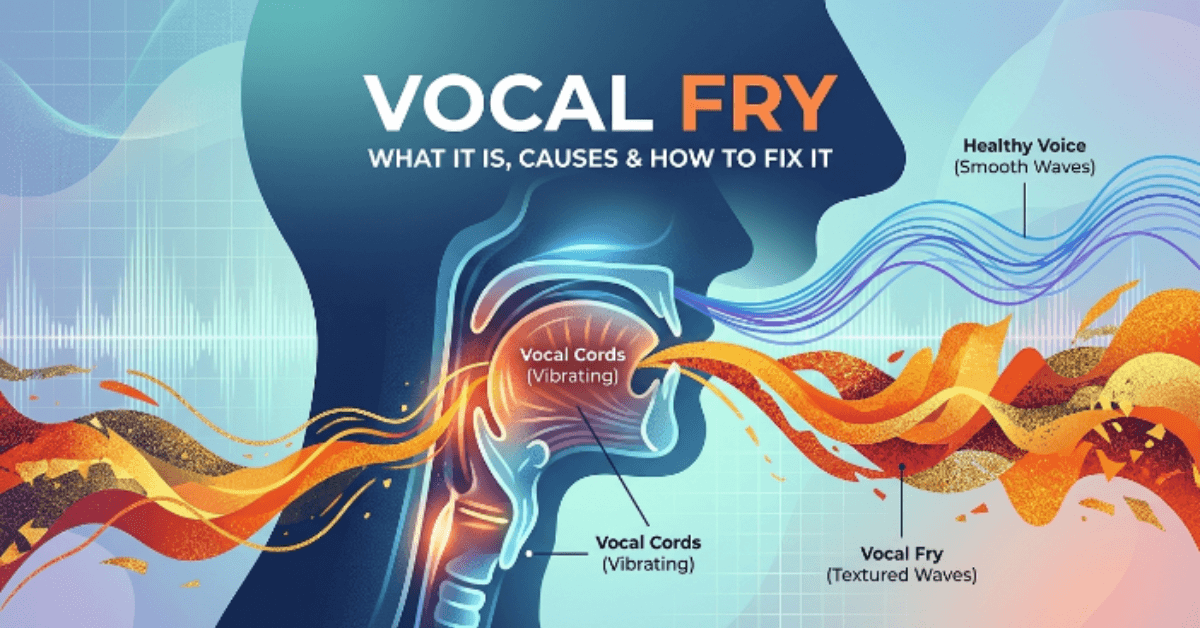
Here’s a simple vocal fry definition: it’s the lowest vocal register, created when the vocal folds are relaxed and vibrate very slowly.
Instead of producing a smooth, steady tone, the folds open and close in separate pulses. That creates a popping, rattling, or creaking sound.
If you’ve ever said “uhhh” in a sleepy voice just after waking up, you’ve probably heard it.
The vocal fry meaning becomes easier to understand when you think of a slowly turning bicycle wheel. At normal speed, the spokes blur together. When the wheel slows down, you can see each spoke pass. The voice works similarly. Slow vocal-fold vibrations become separate, audible pulses.
It’s also known as:
- Pulse register
- Creaky voice
- Glottal fry
- Glottal scrape
- Laryngealization
These names sound medical, but the sound itself can occur naturally in healthy voices.
What Does It Sound Like?
A common vocal fry example is the low creak you may hear when someone reaches the end of a sentence. As their breath runs low and their pitch drops, the voice begins to crackle.
In singing, it may appear as a brief raspy sound before a clear note. Britney Spears’ opening delivery in “…Baby One More Time” is a well-known pop example. Artists may use a similar effect to make a lyric feel intimate, tired, vulnerable, or dramatic.
Try this gently:
- Imagine you’ve just woken up.
- Say “uh” in a quiet, lazy voice.
- Let the pitch sit low without pushing it down.
- Notice the soft, bubbly sound.
That’s the register. It should feel easy. If your throat tightens or the sound hurts, stop.
What’s Actually Happening in Your Voice?
During regular singing, air from the lungs passes through the vocal folds and causes them to vibrate quickly. Pitch changes as their length, tension, and position change.
In the fry register, airflow is very low, and the folds are loose. They stay closed longer and open briefly to release small bursts of air. Those individual bursts create the familiar crackle.
This is why the sound usually feels quiet. Trying to make it loud by squeezing harder defeats the purpose and may create unnecessary pressure.
Think of it as a small candle flame. It can add atmosphere, but blowing harder doesn’t make it a fireplace.
What Causes Vocal Fry?
There isn’t one single cause. Sometimes it’s a natural register. Sometimes it’s a habit. In other cases, it appears because the singer’s voice or breath isn’t working efficiently.
1. Your pitch has dropped too low
Every voice has a comfortable speaking and singing range. When you drop below the lowest clear note your folds can sustain, the sound may naturally move into fry.
This often happens at the end of a spoken sentence or sung phrase.
2. You’re running out of breath
Have you noticed that the last few words of a long phrase sound weak and creaky?
You may not have enough steady airflow to finish the phrase clearly. The pitch drops, the energy disappears, and the voice falls into its lowest register.
Taking a bigger breath isn’t always the answer. Better breath timing and more controlled airflow usually matter more.
3. Your voice is tired
Long rehearsals, repeated takes, loud talking and singing without breaks can leave the voice fatigued. A tired voice may lose clarity, volume or stability.
The creaky sound can then become more noticeable, particularly in the morning or after heavy voice use.
4. It has become a speaking habit
Many people use a creaky ending without realizing it. Speech habits can travel into singing, especially during quiet verses or conversational pop songs.
There’s nothing automatically wrong with the habit. However, it may reduce clarity when you want a confident, connected tone.
5. You’re copying another singer
A stylistic effect can slowly become a default setting.
If you regularly imitate artists with breathy, raspy, or creaky voices, your own voice may start using the sound even when the song doesn’t call for it.
Influence is normal. The key is learning the technique rather than copying only its surface sound.
6. You’re deliberately using it for expression
Sometimes the cause is simple: you chose it.
A brief creak can add personality to a lyric, lead into a low note, or make a phrase sound more intimate. That isn’t a flaw; it’s a creative decision.
Natural Register, Artistic Effect or Warning Sign?
Use this quick check:
| What you notice | What it may mean |
| A brief creak on a low note that feels comfortable | A natural or stylistic effect |
| The sound appears mostly at the ends of long phrases | You may be losing breath energy |
| It happens after a long rehearsal | Your voice may be tired |
| It appears in nearly every phrase | It may have become an automatic habit |
| You need to squeeze to produce it | Your technique needs adjustment |
| It comes with pain, burning or lasting hoarseness | Stop and seek professional guidance |
The sound alone doesn’t tell the whole story. Comfort, control and recovery matter more.
Is It Bad for Your Singing Voice?
Used briefly and comfortably, it isn’t generally considered harmful. The vocal folds are loose, and airflow is low.
However, “natural” doesn’t mean you should force it.
Trying to make the effect louder, darker, or more dramatic by pressing the throat can create tension. Repeating any sound with poor technique may also contribute to fatigue.
A healthy effect should:
- Feel easy
- Require little air
- Stay at a comfortable volume
- Stop when you choose
- Transition smoothly into a clear note
- Leave your speaking voice feeling normal afterward
If you experience pain, loss of range, or ongoing hoarseness, don’t keep practising through it. The NIDCD advises avoiding speaking or singing when the voice is hoarse or tired. It also recommends medical evaluation when hoarseness lasts longer than three weeks without a cold or flu.
How to Stop Unwanted Vocal Fry When Singing
You don’t fix a creaky voice by trying to sound brighter or louder. First, work out why it’s happening.
1. Return to a comfortable pitch
Speak the lyric naturally before singing it. If the spoken version sits extremely low, raise the pitch slightly.
Now sing the phrase on a comfortable note. Keep the tone easy and clear before returning to the melody.
If the original key repeatedly pushes you below your usable range, the song may need to be transposed.
2. Check where you breathe
Mark the places where you’ll inhale. If the crackle always appears on the final words, shorten the phrase or take an earlier breath.
Try speaking the lyric with steady energy from beginning to end. Then sing it without allowing the last word to collapse.
3. Use a gentle hum
Hum the phrase on “mm” at a comfortable pitch. Feel a light vibration around your lips and face.
Next, open the hum into the song’s vowel:
- “Mm-mah”
- “Mm-mee”
- “Mm-moh”
This can help you find a clearer tone without pushing.
4. Try lip trills
Sing the melody through a relaxed lip trill. This encourages steady airflow and reduces the urge to grip the throat.
If the lips stop vibrating before the phrase ends, your airflow may also be dropping too soon.
5. Use a clear “mum” or “gee”
Sing the troublesome phrase gently on “mum” or “gee.” Choose the one that feels easiest.
Then return to the lyrics while keeping the same clear, balanced feeling.
Don’t chase volume. Clarity comes before power.
6. Record the phrase three ways
Sing the same line:
- With a deliberate creaky opening
- With a clean, clear opening
- With a small touch of texture
Listen back and ask which version supports the lyric best.
This exercise changes the sound from an unconscious habit into an artistic choice.
7. Protect the voice between practice sessions
Technique is only part of the solution. Sleep, hydration, warm-ups, rehearsal length, and speaking habits can all affect how reliably your voice responds.
These vocal health tips can help you build a routine that supports both practice and performance.
How Singers Can Use It Creatively
A creaky tone isn’t just something to “fix.” When controlled, it can be a useful colour in your vocal palette.
You might use it to:
- Add vulnerability at the beginning of a lyric
- Create a relaxed or conversational sound
- Approach a low note
- Give a phrase a darker colour
- Add contrast before a clean tone
- Create a brief pop, R&B, indie or folk-style effect
- Help explore vocal-fold relaxation during an exercise
The key word is brief. If every line uses the same texture, it stops feeling expressive and starts feeling predictable.
A little salt can improve a meal. Pouring in the whole shaker hides every other flavour.
When Should You Work with a Vocal Coach?
Online exercises can help you notice a habit, but they can’t hear what’s happening in your individual voice.
A coach can help you determine whether the sound is caused by:
- Low pitch
- Weak breath management
- Fatigue
- Excess tension
- Song-key selection
- A speaking habit
- A deliberate stylistic choice
Good training doesn’t erase your personality. It gives you more options.
If your voice feels tight when switching styles or adding rasp, learn how to sing with less vocal strain. Singers who want personalised help can explore private vocal lessons, while dedicated performers looking for regular, focused development may benefit from elite private coaching.
Frequently Asked Questions
What causes vocal fry?
It can happen when the voice drops into its lowest register, airflow becomes very low, or a singer reaches the end of a phrase without enough breath energy. It may also appear because of fatigue, speaking habits, imitation, or an intentional stylistic choice.
Is it bad for your singing voice?
Not necessarily. Brief, relaxed use shouldn’t hurt. The concern is forcing the effect, adding pressure or continuing when your voice feels painful, tight or unusually hoarse.
How can I stop it when I sing?
Start by identifying where it appears. Use a comfortable pitch, plan your breaths, practise the phrase with humming or lip trills, and record yourself. If the habit continues, a vocal coach can help identify its cause.
Is it a stylistic choice or a vocal problem?
It can be either, but it’s often simply a natural register. If you can turn it on and off comfortably, it may be a useful artistic choice. If it happens constantly, limits your tone, or comes with discomfort, it deserves closer attention.
Final Thoughts
Your voice doesn’t need to be perfectly smooth to be healthy or beautiful. Texture can make a performance feel human.
The important question isn’t, “Do I ever make a creaky sound?” It’s, “Can I choose when and why I use it?” Learn to produce a clear tone first. Then treat texture as a colour, not a cover-up for poor breath support or tension. Once you have that control, you won’t have to fear the crackle. You’ll know when it serves the song and when it’s time to let the note ring clearly.
